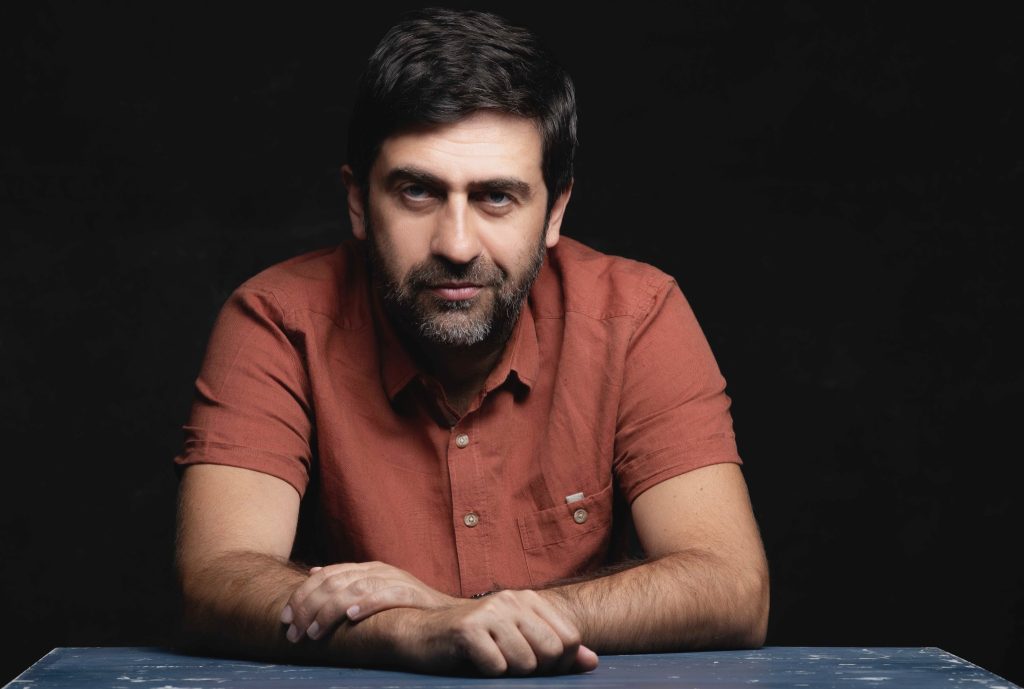
Kinenova: Why cinema? As a historian, what fascinates you about this art form?
Emin Alper: Essentially, cinema was my first love. In my biography, cinema comes before my interest in history. Even as a child, I was drawn to storytelling, and I wanted to tell stories myself. While I was in high school, I decided to become a filmmaker because I was enchanted by the films I watched. After graduating, however, I somehow decided to pursue my thesis in history. That was when I found myself as a historian. In my intellectual and artistic world, throughout my career, these two disciplines have complemented one another. I think cinema is a very powerful way of presenting history, society and human psychology at the same time. As a historian, I am interested in how people are shaped by their history and social circumstances. Cinema allows me to explore these processes not only intellectually, but also emotionally and visually.
Kinenova: Your favourite directors include Kusturica, Fassbinder, Visconti and Haneke. What do you see in their films?
Emin Alper: I admire directors who can combine their personal visions with a deep understanding of society and human psychology. Kusturica was the director who convinced me that I should become a filmmaker. He has an extraordinary sense of energy and absurdity. Later on, his influence on me faded. Fassbinder and Visconti are very powerful in their portrayals of social structures and class relations. I love Visconti’s historical perspective and the way he portrays his passionate characters in a historical and social context. Haneke, on the other hand, is extremely precise and explores violence and alienation. What connects me to them is that their films are deeply personal and political at the same time.
Kinenova: In your films, we encounter harsh realism, magical realism and dark neorealism, through which you create human stories that seem very simple, yet are also complex. How do you achieve all this in a single film?
Emin Alper: I do not really think about styles and genres when I start working on a film. Usually, the story and the psychological world of the characters come first. The visual style emerges from the needs of the story. I think different elements can coexist naturally if they serve the same emotional and dramatic world. But whenever I finish a film, I realise how I have used all those genre elements you mentioned. This is not a coincidence, because all these narrative tools fascinate me as a viewer. Perhaps when I want to tell stories that truly shock me or move me emotionally, I use these tools to affect the audience in the same way. I think stripped-down realism is not suitable for creating the effect I want to achieve. Although my stories have a realistic foundation, I always want to create a style that goes beyond the boundaries of reality.
Kinenova: Do any of your characters exist in real life? Have you created characters based on people you actually know?
Emin Alper: Sometimes I borrow certain traits from people I have met, but my characters are never direct portraits of real people. They are usually a combination of different observations, experiences and imagination.
Kinenova: Your characters are often marked by an inherent darkness. Do you think darkness is more present and more powerful than light in this uncertain world?
Emin Alper: I do not think darkness is more powerful than light. But I am interested in that darker side of human nature because it is so often hidden behind ordinary social life. Moments of crisis can reveal this side very openly and clearly. Humanity’s dark side is harder to accept and much harder to understand. That is why I am drawn to it. Politically, too, if we want to live in a better world, we definitely have to confront our dark sides.
Kinenova: Do you think filmmakers, as intellectuals, should be socially and politically engaged through their films?
Emin Alper: I do not think this should be a universal rule for filmmakers. Every director, writer and screenwriter has their own way of communicating with reality and responding to it through art. But cinema inevitably reflects the society in which it is created. Even when a filmmaker tries to avoid politics, that effort can have political implications. For me, it is very important to remain sensitive to the social and political reality around us. Especially if you live in a country like mine, it takes a particular effort to avoid politics in your work. At least, that is how I experience the relationship between art and everyday life.
Kinenova: Do you allow actors and actresses to improvise?
Emin Alper: Yes, but within certain limits. I usually have a very clear idea of each scene, and I do not want the actors simply to reproduce what I have imagined. I encourage them to bring their own understanding and instincts to their characters. I am more open to improvisation during rehearsals. When I like something during rehearsals, I tell them to keep it. I want actors to arrive on set prepared, but I am not completely closed to improvisation on set either.
Kinenova: What can you tell us about the film fund in Türkiye? Do you receive financial support from it for your films?
Emin Alper: The national film fund is very important for Turkish arthouse filmmakers, especially younger ones. I made my first two films with support from this fund. However, over the past decade or so, the allocation process has become highly partisan, and filmmakers critical of the government have been excluded from its support. I have not been able to obtain that support for my last three films. This has made financing my projects extremely difficult.
Kinenova: Do you have a favourite among your own films? What makes it special to you?
Emin Alper: It is difficult to choose one. I have a strong emotional connection to all my films in different ways. Beyond the Hill has a special place in my heart because it was my first feature film, and in it I established the main themes that would continue through my later projects. Frenzy was perhaps the most challenging for me, and I love its atmosphere. I also love A Tale of Three Sisters because it is quite personal to me. I love the darkness, visual style and political content of Salvation as well.
Kinenova: What do you know about Macedonian cinema?
Emin Alper: Unfortunately, my knowledge of directors from Macedonia is limited. Of course, I know Milcho Manchevski. Before the Rain had a great influence on me when I watched it as a young student who wanted to become a filmmaker. I love Honeyland; it is a documentary of great emotional power. I also follow and enjoy Teona Mitevska’s recent films. Teona is also a friend of mine.
Kinenova: Kinenova is a festival that celebrates new and powerful cinematic voices. What advice would you give them?
Emin Alper: I would advise them not to spend too much time following trends. They should try to discover their own voice and make the films they sincerely feel they need to make. Above all, they should watch as many films as possible from different genres.